
Criminal Cases in the Grimes County Courts
Grimes County court case records split by the level of the charge. The 12th and 506th Judicial District Courts exercise felony trial jurisdiction, and the District Clerk keeps those files after a grand jury returns an indictment. The Grimes County Court at Law hears Class A and Class B misdemeanors and other assigned matters. Its closed dispositions route through the County Clerk. Fine-only cases may remain with a justice court, while a city ordinance or fine-only case arising in Navasota can remain at Navasota Municipal Court. The court name on a citation, bond form, or case number is therefore the first key to the right file.
The official Grimes County District Clerk page identifies the felony custodian and the current public counter. The page image below helps connect that office with the court records it maintains.
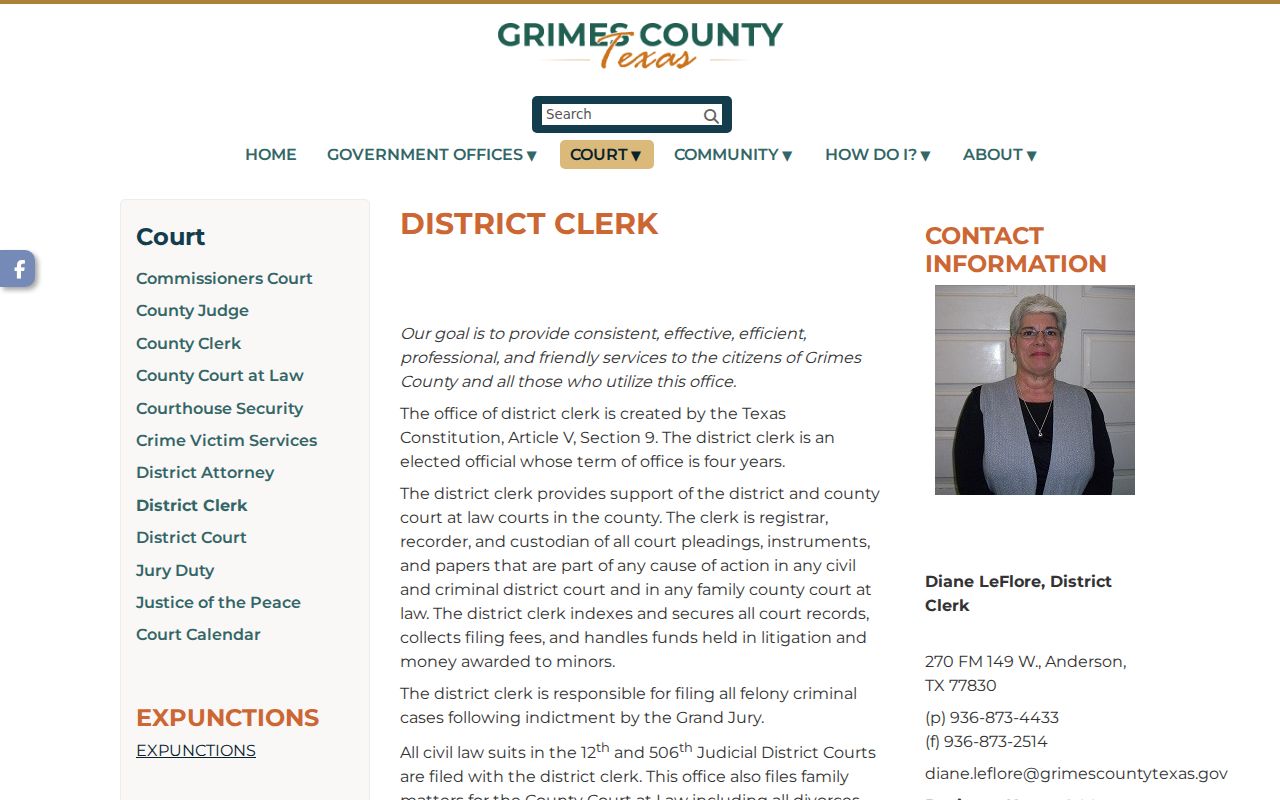
For a felony file, the District Clerk at 270 FM 149 West in Anderson can be reached at 936-873-4433, while the Criminal Deputy line is 936-873-4432. The public counter is open Monday through Friday from 8:00 a.m. to 4:00 p.m.
Grimes County Felony Case Routes
A complaint and an arrest do not, by themselves, create a felony indictment file. After prosecutor review, the grand jury may return a true bill. The indictment is then filed with the Grimes County District Clerk in the proper district court. A no bill means the grand jury declined to indict, but it does not make the booking record vanish. This division is one reason a Grimes County criminal court case may not appear where a reader first expects it.
Misdemeanor cases take a different route. A prosecutor commonly files an information, and the County Court at Law docket then tracks settings, pleas, motions, and the result. The Grimes County Clerk page is the county-level record route, not a substitute for the District Clerk's felony archive.
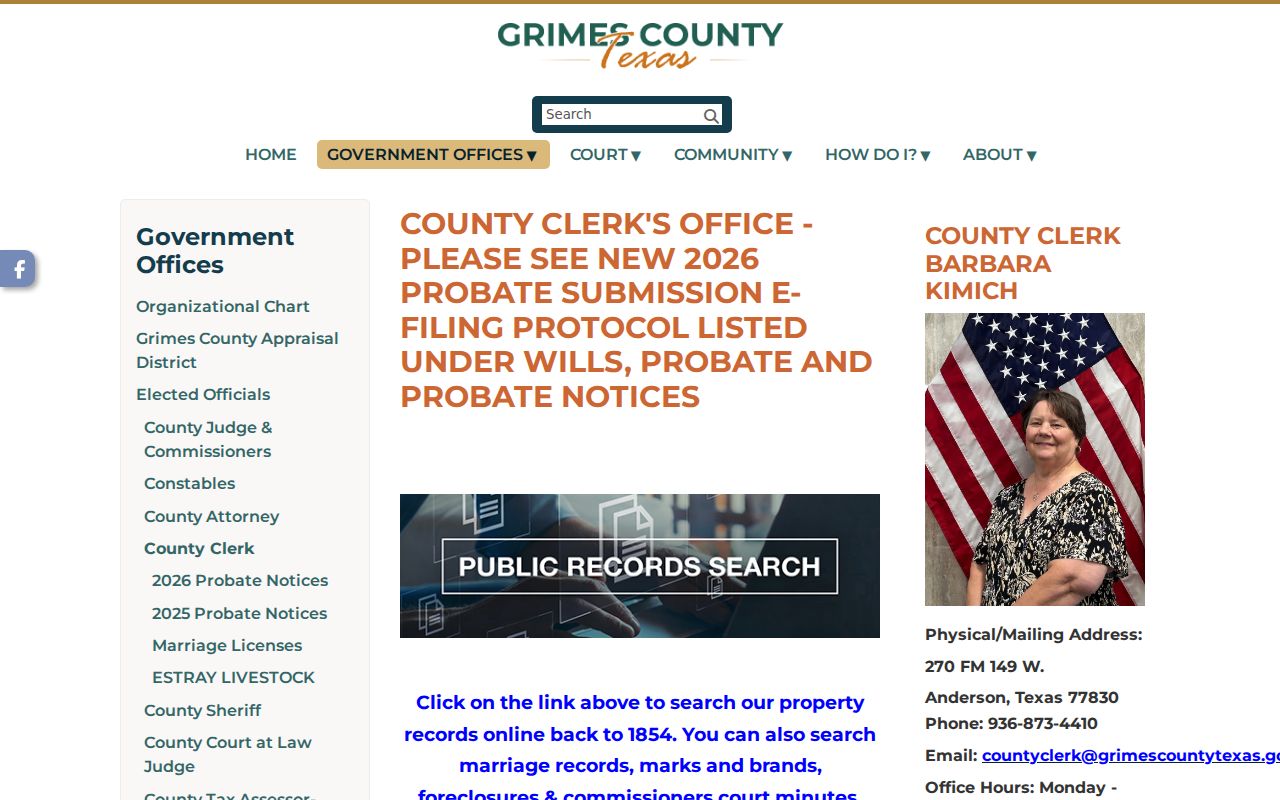
The County Clerk is also at 270 FM 149 West, can be reached at 936-873-4410, and publishes counter hours of 8:00 a.m. to 4:30 p.m. on weekdays. Naming the court and case number will keep a request from being sent between offices.
How to Search Case Records
The county presents LGS Online Records Search as its clearest local route for criminal cases. Guest access can reveal an index, while an account is needed for permitted image access and downloads. Searchers should treat the index as a lead. The signed judgment, dismissal, deferred-adjudication order, or other final order is the best proof of the court's action.
- Open the county's LGS route and choose an account or Guest Login.
- Select Search, pick the correct clerk office, and choose the Criminal record type.
- Enter at least one offered criterion, such as the last name, and run the query.
- Use the page controls and open More Information to compare the court, case number, filed date, charge, and status.
- Use Images when a public document is offered, or ask the correct Grimes County clerk for the signed final record.
The LGS Online Records Search screen supplies the controls summarized below.
| Field or control | Type | Required | How it works |
|---|---|---|---|
| Account or Guest Login | Authentication | Yes | Guest access shows the index; an account enables allowed image access. |
| Office | Dropdown | Yes | Choose the clerk office that holds the Grimes County case. |
| Record Type | Dropdown | Yes | Select Criminal; options can vary by office. |
| Search criteria | Conditional fields | At least one | The county example uses Last Name; labels depend on record type. |
| More Information | Result action | No | Opens the case index or detail view. |
| Images | Result action | No | Appears only when a public image is available. |
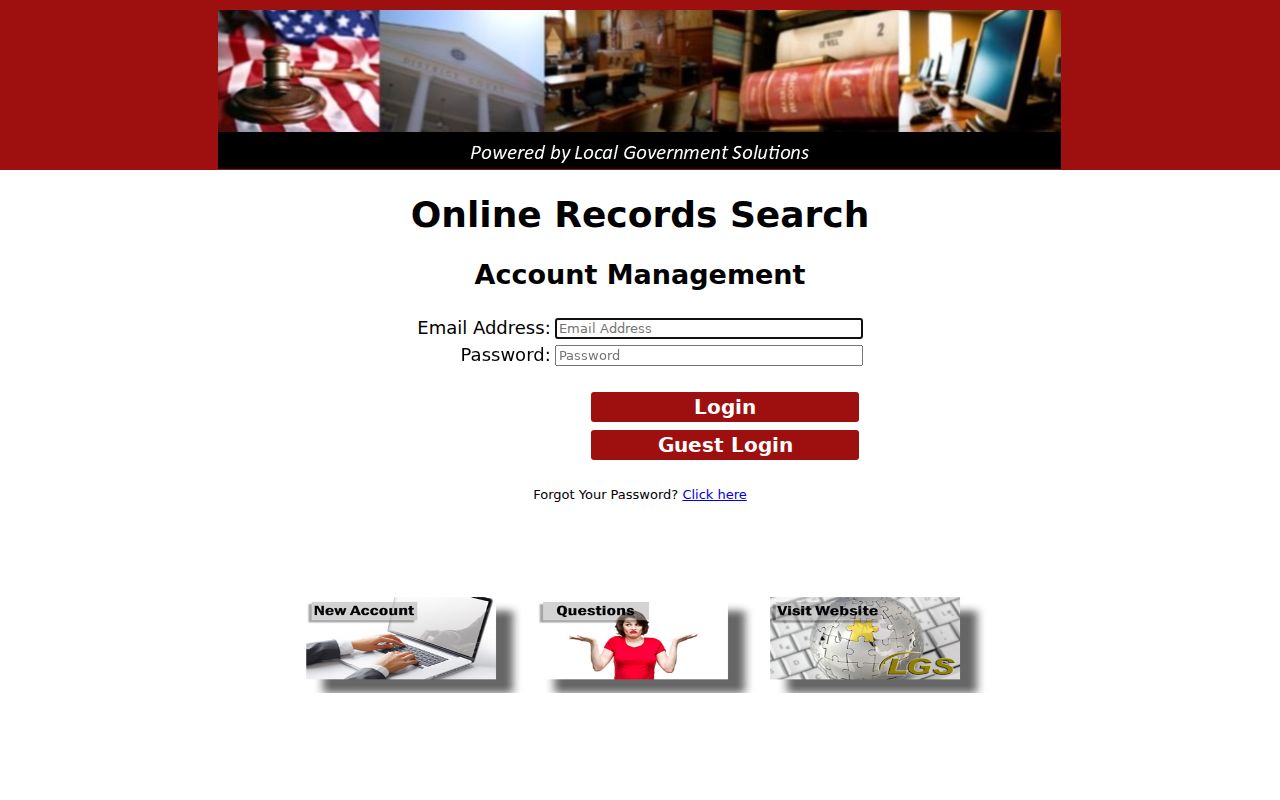
The portal can shorten the search, but suppressed details, missing images, and older paper holdings still require direct clerk help.
Grimes County Criminal Case Portal Choice
The county also points to re:SearchTX, but its statewide name can invite a wrong assumption. The Texas Office of Court Administration describes the re:SearchTX document collection as civil. It can serve as a supplemental index or document channel, yet it should not replace LGS or a Grimes County clerk when the goal is a local criminal disposition.
The re:SearchTX portal requires registration. Public documents cost $0.10 per page with a $1 minimum per document, and a purchased item can remain downloadable for up to 30 days.
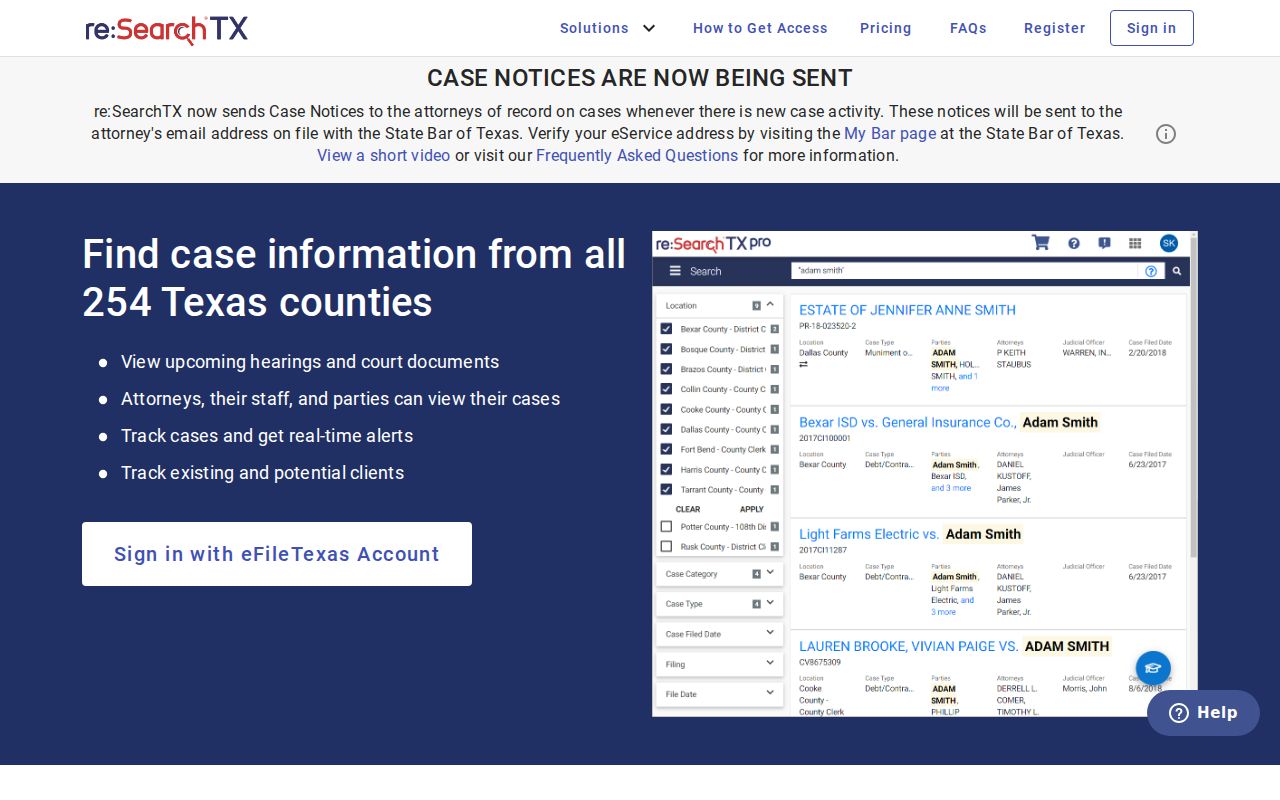
That fee and access model differ from the local clerk schedule. A statewide result should be matched to the Grimes County case number and then checked against the signed local order.
Note: A missing re:SearchTX document does not establish that no Grimes County criminal case exists.
What the Case File Shows
A Grimes County criminal court file records the prosecution after filing. It can show what charge reached court, how that charge changed, what hearings occurred, and what judgment was signed. The file is distinct from the sheriff report and jail booking sheet. Those records document the alleged event and custody, while the court file records pleas, motions, rulings, and disposition.
| Case number and court | Identifies the docket and the clerk office that owns it. |
|---|---|
| Parties and counsel | Usually lists the State of Texas and defendant; counsel may appear in filings. |
| Charging document | Shows the complaint, misdemeanor information, or felony indictment and entered counts. |
| Docket events | May list filings, settings, arraignment, motions, orders, pleas, and warrant or capias events. |
| Disposition and judgment | Records dismissal, acquittal, deferred adjudication, conviction, or another court result. |
| Sentence and financials | May show punishment, community supervision, restitution, fines, and costs; confirm balances with the clerk. |
Some words need care. A disposition is the recorded outcome. An indictment is a grand-jury charging instrument, not a conviction. Deferred adjudication postpones a finding while a person completes community supervision and is not an acquittal. A capias is a court writ commanding arrest. Reading those terms in context prevents a docket event from being mistaken for the final result.
Grimes County Misdemeanor Case Dockets
The County Court at Law publishes docket links and a court-date line at 936-873-4472. That channel can help confirm when a Grimes County misdemeanor is set, but a calendar entry is not the full case file. Closed County Court at Law dispositions go back to the County Clerk. Readers seeking the outcome should request the signed final document instead of relying on a name listed on a setting sheet.
The official Grimes County court dockets page also states courtroom rules.
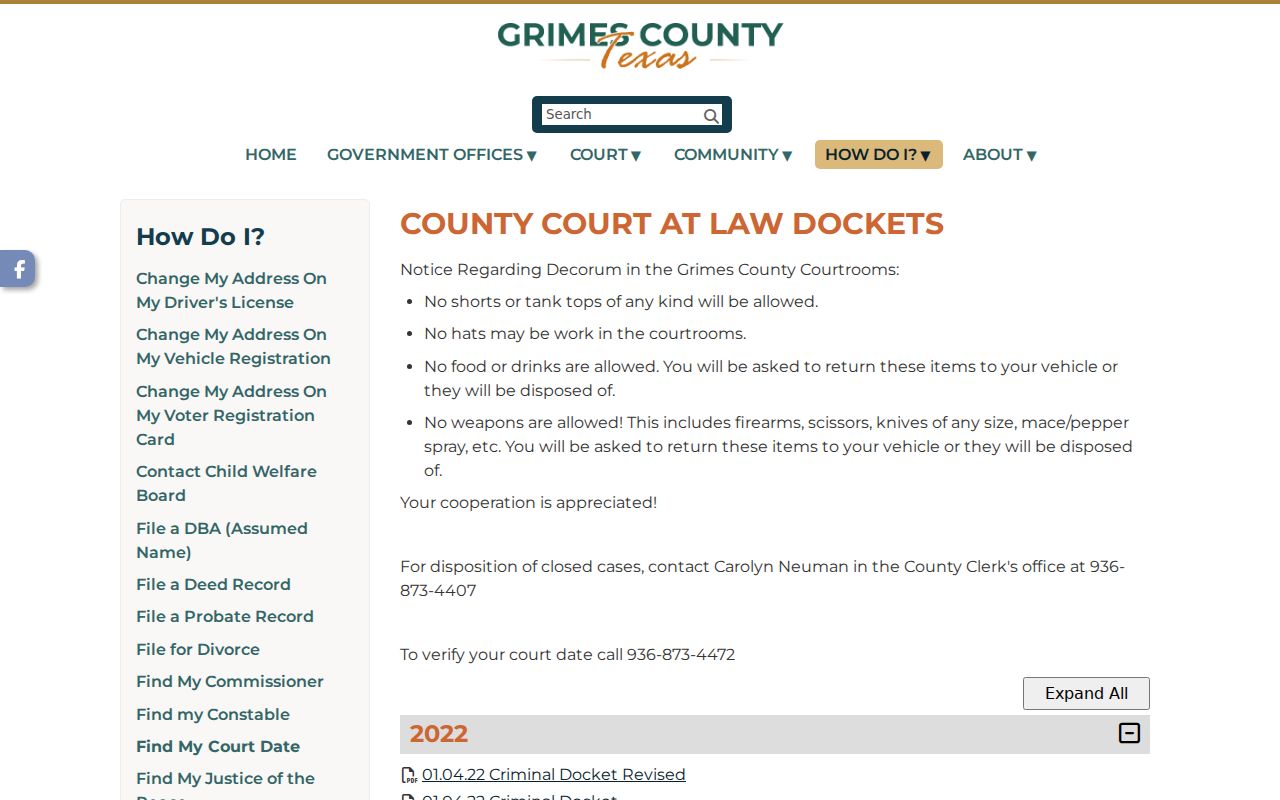
Visitors may not bring weapons, including firearms, knives, scissors, or mace, and the posted decorum rules also bar hats, shorts, tank tops, food, and drinks. These rules matter for a docket visit even when the main task is obtaining a record.
Stages of a Criminal Case
A Grimes County case can start with an arrest or summons, followed by a complaint and prosecutor review. A person arrested must receive magistration without needless delay, generally within 48 hours under Texas Code of Criminal Procedure Article 15.17. A misdemeanor may proceed by information, while a felony usually reaches District Court after grand-jury indictment. Arraignment follows, then motions, discovery, and hearings. The case can end through a negotiated plea, dismissal, acquittal, or conviction after trial. Judgment, sentence, appeal rights, and community supervision can create later docket events.
Case flow: Charges Filed › Arraignment › Pretrial › Plea or Trial › Disposition › Sentencing
A filed charge is not proof of guilt. The Grimes County arrest history can explain the earlier booking, while the clerk's signed order establishes what the court did.
Grimes County Court Copies and Fees
An index answer is often enough to locate a case, but it may not resolve what happened. When an online Grimes County criminal case has no image, note the full case number, court, party name, and filing date. Ask for a named record, such as the signed judgment, dismissal, or deferred-adjudication order. This is more precise than asking the clerk to explain the case, and clerks cannot give legal advice.
The county's District Clerk fee sheet separates research, copies, and certification. A District Clerk civil or criminal record search is $5. Paper is $1 per page. Electronic copies are $0.10 per page with a $1 minimum per document, and certification or exemplification adds $5 each. The County Clerk states regular copies are $1 per page and certification adds $5 per document.
The county's court search explanation shows how the local and statewide routes differ.
The guide reinforces a practical rule: use the online index to identify the file, then use the responsible clerk for an authoritative copy.
Older Grimes County Criminal Case Records
Digital coverage is not the same as the age of the clerk's archive. Grimes County Clerk online holdings for court and probate records reach back to 1893, and the District Clerk keeps naturalization records dating to the mid-1800s. Those facts show why older Grimes County files may exist even when a modern portal returns no match. Indexing, images, and record types can have different start dates.
For an old criminal case, provide a name variation, approximate year, likely court level, and any number found in a family file or newspaper. Ask whether the matter is in an index, bound book, paper file, or another archive. Genealogy research often benefits from separating naturalization material from a criminal docket, since both may be held by the same office but use different search paths.
Note: A portal no-match is a prompt to check archival holdings, not proof that the Grimes County file never existed.
Access & Restrictions
Texas Government Code Section 552.021 supports public access to information held by a government body unless an exception applies. That principle does not make every part of a Grimes County court file public. Juvenile and mental-health records are described by the County Clerk as sealed or unavailable online. Sensitive identifiers may be redacted. Expunged and nondisclosed material is restricted under separate Texas law, and some images can be withheld even when an index entry remains visible.
Under Texas Government Code Chapter 552, a precise written request should seek an existing document rather than ask the clerk to conduct legal research. Name the court, case number, date range, and exact record. If the public view lacks a final image, contact the clerk and ask whether inspection, an electronic copy, a paper copy, or certification is available.
Verify the disposition: A charge, setting, or deferred status is not the same as a conviction. Use the signed Grimes County judgment or final order.
Restrictions can also change what appears in a statewide system. The public Texas DPS product chiefly covers reported convictions and deferred adjudications, while the local court file supplies the pleadings and signed result. Checking both may expose a missing disposition that should be corrected with the originating court and Texas DPS.